
Book An Appointment
802 Southdown rd, Unit # C1, Mississauga, ON, L5J 2Y4
Email: goactive.mississauga@gmail.com
Book Appointment Call UsMore Recent Blogs
Sun Mar 1
The Shocking Truth About School Backpack Injuries in Children: Real Stats & 5 Safety Tips
Why Your Child's Backpack Is a Bigger Problem Than You Think
It's the first week of September. Your child is excited about school. Their backpack is freshly packed. And somewhere tucked between the textbooks, binders, a lunch bag, and a forgotten water bottle from last year — is a problem that most parents don't notice until it starts to hurt.
School backpacks are one of the most overlooked sources of musculoskeletal pain in children. Not because the research isn't there — it very much is — but because the discomfort builds slowly, and kids often don't say anything until it becomes hard to ignore.
At GoActive Physiotherapy, our clinical team sees this pattern repeat every September and October. A child comes in with shoulder or neck pain, and after a few questions, it becomes clear: the backpack is too heavy, it's worn wrong, or both. The encouraging news is that this is almost entirely preventable once you know what to look for.
This post brings together the best available research — including Canadian clinical observations and international peer-reviewed studies — to show you exactly how widespread this problem is, and what five things you can do about it right now.
📊 SECTION 1: THE NUMBERS — CANADIAN & GLOBAL EVIDENCE
What the Research Actually Shows
Let's start with the numbers, because they tell a clearer story than most parents realize.
| 37% of children ages 11–14 report back pain from backpacks (PubMed population study, 1,540 children) | 52% of school children carry bags exceeding 15% of their body weight (PMC, 2025 cross-sectional study) | 14,000+ children treated annually for backpack-related injuries in the US (US Consumer Product Safety Commission) |
| 50% higher risk of back pain in children carrying the heaviest loads (PubMed, Rodriguez-Oviedo et al., 2012) | 96% of school-age children are carrying bags that are too heavy (US Consumer Product Safety Commission estimate) | 60% of orthopedic doctors are actively treating children for backpack-related back pain (CPSC clinical survey) |
These aren't isolated findings. The research spans Canada, the United States, Europe, and further — and the pattern is consistent. Heavy backpacks, worn incorrectly, cause real pain in children whose spines are still developing.
The Canadian Picture
In Canada, physiotherapists across the country — including those practicing in Ontario — are seeing this firsthand. CBC News spoke with Moncton-based physiotherapist Julie McGivery in September 2024, who described it clearly: children who carry heavy bags over long walking distances are at risk of developing skeletal problems that can progress to conditions like scoliosis and chronic headaches.
The Canadian Association of Occupational Therapists has also published guidance on backpack safety, noting the importance of fit, weight distribution, and carrier habits — particularly for children in the primary and middle school years.
Canada does not currently have a national pediatric backpack injury registry, but clinical data from physiotherapy and orthopedic practices across provinces points to the same conclusion: this is common, it is undertreated, and it is preventable.
Breaking Down the Risk: What These Numbers Mean for Your Child
A Spanish study published in Archives of Disease in Child (2012) analyzed 1,403 school children and found that 61.4% had backpacks exceeding 10% of their body weight. Those carrying the heaviest loads had a 50% higher risk of back pain and a 42% higher risk of back pathology.
A PubMed meta-analysis examining 1,540 children aged 11–14 found that 37% reported back pain. The study also confirmed that children with access to school lockers reported significantly less back pain — pointing to how much simple environmental changes can help.
A cross-sectional study published in PMC (2025) found that among students who reported back pain, 85% had self-medicated without consulting a healthcare provider. That number should concern every parent.
Research involving a Canadian Armed Forces female anthropometric model (IOSR Journal of Humanities and Social Science) showed that backpack weight had the greatest single influence on shoulder strap tension and shoulder pressure — more than carrying style, strap length, or gait speed.
📌 Key Takeaway: The weight of the bag is the single most controllable risk factor. Everything else — strap width, bag fit, lifting technique — helps. But first and foremost, the bag must not be too heavy.
Where Children Are Hurting — and Why
Pain from backpack misuse doesn't always show up in the obvious place. A 2020 PMC study found that among children carrying bags over 10% of their body weight, the areas of pain reported in order of frequency were:
- Shoulders — reported by 50% of affected children
- Between the shoulder blades (interscapular) — 35.9%
- Neck (cervical region) — 20.5%
- Lower back (lumbar) — 17.9%
Girls consistently report more intense and more frequent pain than boys across multiple studies, which researchers believe relates to differences in body composition and muscle mass relative to load.
A cross-sectional UK study of 679 children ages 11–14 found that 27% reported neck pain, 22% reported low back pain, and 18% reported upper back pain. These are numbers we'd expect to see in adult office workers — not growing children.
⚠️ 5,000 children visit emergency departments every year for backpack-related injuries. These are not just sore muscles — these are acute incidents that required urgent care. (US Consumer Product Safety Commission)
✅ SECTION 2: TOP 5 BACKPACK SAFETY TIPS — FOR PARENTS AND CHILDREN
The research is clear on what works. These are not generic suggestions — they are drawn directly from clinical evidence and physiotherapy practice guidelines. Each tip below is laid out with a specific action for parents and a version that works for kids.
⚖️ TIP #1 — CONTROL THE WEIGHT — UNDER 10% OF BODY WEIGHT
| 👨👩👧 FOR PARENTS Weigh your child's backpack at home using a kitchen scale — before the first day of school and again every few weeks. It should be under 10% of your child's body weight. For a child who weighs 40 kg (88 lbs), that means the bag should weigh no more than 4 kg (about 9 lbs). The American Academy of Pediatrics and physiotherapy guidelines across Canada align on this threshold. If the bag is over, remove items that don't need to go to school that day. | 🎒 FOR CHILDREN Ask yourself every morning: 'Do I actually need all of this today?' Leave textbooks at school when possible, use your locker between classes, and tell a parent or teacher if your bag feels too heavy. It's not complaining — it's protecting your back. |
🎒 TIP #2 — ALWAYS USE BOTH STRAPS — NEVER ONE SHOULDER
| 👨👩👧 FOR PARENTS Studies consistently show that single-shoulder carrying is one of the strongest predictors of back and neck pain in school children. When the bag is on one shoulder, the spine compensates by curving to the opposite side. Over weeks and months, that repeated asymmetrical load contributes to muscle imbalances, postural changes, and in some cases, functional scoliosis. Make it a house rule: two straps, every time. If the backpack has a chest or waist strap, encourage your child to use those too. | 🎒 FOR CHILDREN Two straps every single day — even if it looks less cool. Wearing it on one shoulder makes your spine lean sideways to balance, and over time that actually changes how your back grows. It's not worth it. Both straps, snug, not swinging. |
📐 TIP #3 — FIT THE BAG TO THE CHILD — POSITION MATTERS AS MUCH AS WEIGHT
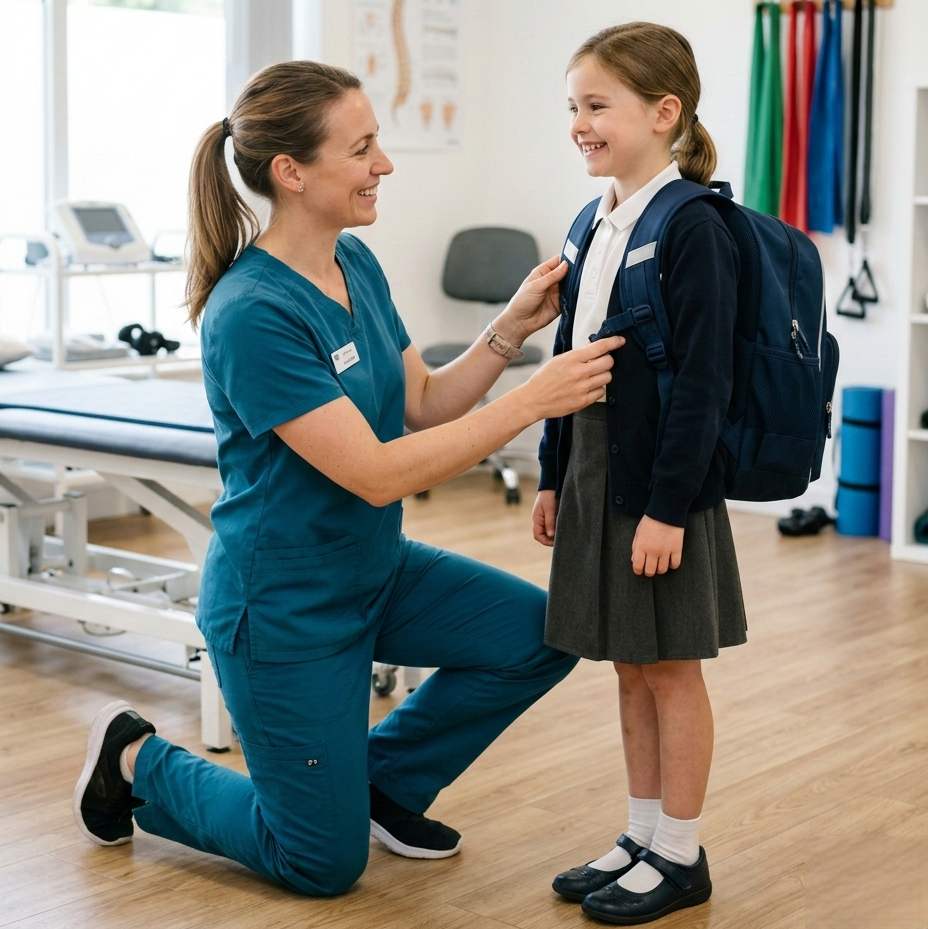
| 👨👩👧 FOR PARENTS The backpack should sit between the shoulder blades and the top of the hip bones — not hanging below the waist, and not riding up above the shoulders. Tighten the straps so the bag presses snugly against the child's back and doesn't sway or swing when they walk. A bag that swings away from the body creates constant pulling forces on the spine with every step — multiplied by the hundreds of steps a child takes each school day. | 🎒 FOR CHILDREN When you put your backpack on, check that it feels close to your back — not hanging away from it. If it swings when you walk, the straps are too loose. Ask a parent or teacher to help you tighten them. The bag should feel like it's part of your back, not pulling away from it. |
📦 TIP #4 — PACK SMART — HEAVIEST ITEMS CLOSEST TO THE SPINE
| 👨👩👧 FOR PARENTS The way items are packed inside the bag matters, even when the total weight is within the safe range. Heavy items — textbooks, laptops, binders — should always go in the compartment closest to your child's back. This keeps the centre of gravity near the spine rather than shifting it backward, which significantly reduces the strain on the lower back and shoulder muscles. Lighter items go in the outer pockets. | 🎒 FOR CHILDREN Put your heaviest books in the back compartment — the one that sits closest to your back. That way the weight stays close to your body instead of pulling you backward. Think of it like holding a heavy bag of groceries: it's easier when it's close to you than when you hold it out in front. |
👁️ TIP #5 — WATCH FOR THE WARNING SIGNS — DON'T WAIT FOR PAIN TO GET WORSE
| 👨👩👧 FOR PARENTS Pain in children is often underreported. They adapt, they minimize, and they often don't connect their shoulder pain to the bag they've been wearing for three months. Watch for red marks or grooves on the shoulders from straps, changes in posture (leaning forward or to one side), complaints of back, neck, or shoulder pain after school, reluctance to put the bag on, or headaches appearing in the afternoon. Any of these signs warrant a closer look — and if they persist, a physiotherapy assessment is the right next step. | 🎒 FOR CHILDREN If your back, shoulders, or neck hurt after school — tell a grown-up. That's not normal and you don't have to just put up with it. Your body is telling you something is wrong. Catching it early means it's easy to fix. Ignoring it means it can get worse and take longer to get better. |
💡 Clinical Note: Physiotherapy education programs focused on backpack safety and postural habits in children showed statistically significant improvements that were maintained at 3-month follow-up (PubMed, 2012). Teaching children these habits early works — and the effects last.
When Is It Time to See a Physiotherapist?
Most backpack-related discomfort in children is caught and corrected early without needing more than a few adjustments and some targeted exercises. But there are situations where a professional assessment is the right call.
Book an appointment with a registered physiotherapist if your child shows any of the following:
- Pain that doesn't improve after a weekend of rest. This suggests something structural, not just temporary fatigue.
- Postural changes that are new or getting worse. Forward head posture, one shoulder higher than the other, or consistent leaning to one side.
- Tingling, numbness, or weakness in the arms or hands. These are nerve-related symptoms that need professional evaluation.
- Pain that interferes with school, activity, or sleep. When pain starts affecting quality of life, it has gone beyond something you should wait out.
- Recurring headaches that appear after a school day. These can be linked to neck muscle tension caused by compensating for a heavy load.
In Ontario, you do not need a doctor's referral to see a registered physiotherapist. Physiotherapists are primary care providers — which means you can book directly and be seen quickly. Early intervention is almost always more effective, less time-consuming, and less costly than treating a problem that has been ignored for months.
📋 QUICK REFERENCE — THE 5 TIPS AT A GLANCE
| # | TIP | THE KEY ACTION |
| 1 | ⚖️ Control the Weight | Keep the bag under 10% of your child's body weight. Weigh it. |
| 2 | 🎒 Use Both Straps | No exceptions. Both straps, snug, every day. |
| 3 | 📐 Fit the Bag Properly | Between shoulder blades and hips. Pressed close to the back. |
| 4 | 📦 Pack Smart | Heaviest items in the back compartment, closest to the spine. |
| 5 | 👁️ Watch for Warning Signs | Don't wait. Red marks, posture changes, and pain need attention. |
📅 Is your child's back giving them trouble? Our registered physiotherapy team at GoActive Physiotherapy offers pediatric postural assessments with no referral needed. Book directly — same week appointments available.
📍 802 Southdown rd, Unit # C1, Mississauga, ON, L5J 2Y4
📧 goactive.mississauga@gmail.com
Sources & References
This blog post is informed by the following peer-reviewed and clinical sources:
- Rodriguez-Oviedo et al. (2012). School children's backpacks, back pain and back pathologies. Archives of Disease in Child. PubMed.
- PMC (2025). Exploring the relationship between schoolbag weight and back pain in primary school children.
- Siambanes et al. (2004). Back pain and backpacks in school children. PubMed (1,540 children, ages 11–14).
- US Consumer Product Safety Commission. Backpack injury statistics (emergency department data).
- Kistner et al. (2012). Effects of backpack loads on posture and postural compensations in children aged 8–11.
- PMC (2020). Relationship between school backpacks and musculoskeletal pain in children 8–10 years.
- Physio-pedia. Backpack Carriage and Low Back Pain in Schoolchildren and Adolescents.
- CBC News (September 2024). Back to school? Watch out for back pain from backpacks, physiotherapist warns parents.
- IOSR Journal of Humanities and Social Science. Back problems due to heavy backpacks in school children.
- Canadian Association of Occupational Therapists. Backpacks: Beasts of Burden. Wagner, D. (2012).
- PubMed (2012). Effects of a postural education program on school backpack habits related to low back pain in children.
Disclaimer: This content is for general informational purposes and does not replace individual medical advice. Go Active Physiotherapy operates in compliance with the standards and regulations of the Ontario College of Physiotherapy. Always consult a registered healthcare provider for personal health concerns.